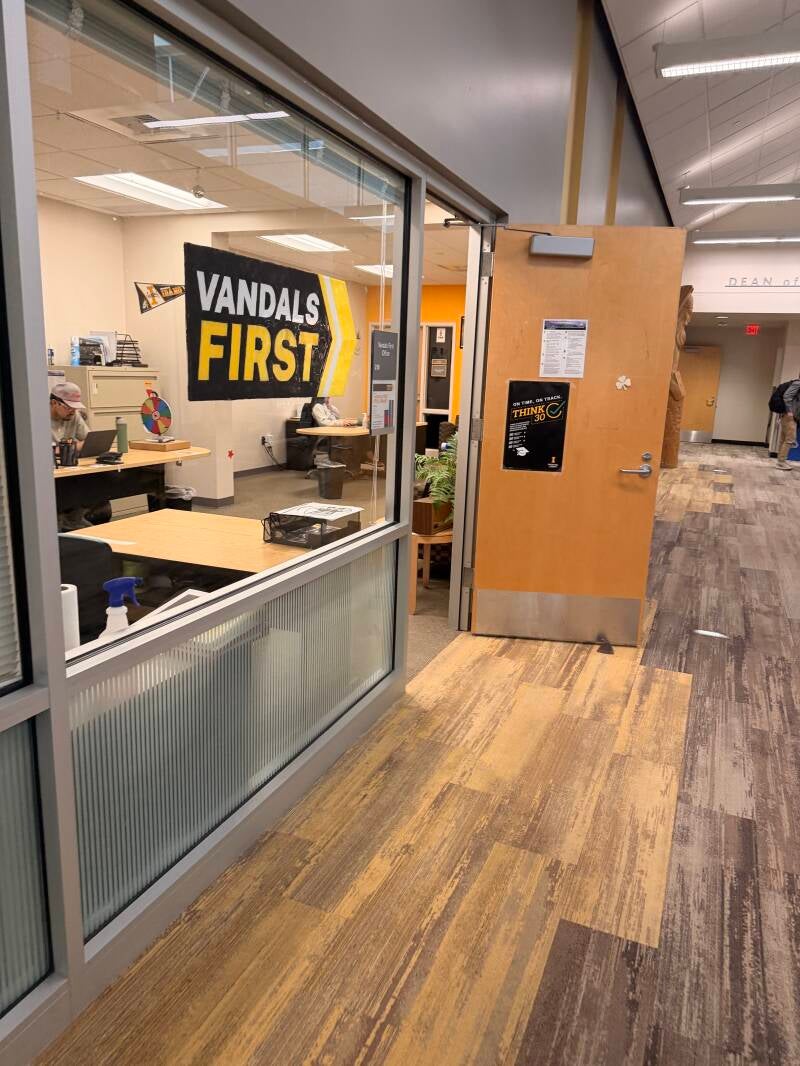
The Office of Multicultural Affairs was changed to the Vandals First office in order to comply with the new DEI restrictions. Photo by Seyi Arogundade.
In April 2025, the Idaho Legislature passed Senate Bill 1198, which stops all public institutions in the state from having offices, staff or training related to diversity, equity and inclusion. According to ACLU Idaho, the law also allows students and staff to sue an institution if they believe the new law has been violated in any way.
In response, the University of Idaho shut down all of its DEI offices, including the Office of Multicultural Affairs, the Black and African American Cultural Center, the Women’s Center and the LGBTQIA+ Office. Along with these closures, all positions tied to the offices were terminated, as well as the associated programs that supported the students involved in them. Now, roughly a year later, students are reeling from the effects of losing these resources.
The changes in Idaho reflect a broader national trend. According to a report published April 6, 2026, by The Chronicle of Higher Education, colleges across the country have been dismantling anything related to DEI in response to legislative and political pressure. The report found that changes have occurred on 450 campuses in 48 states and Washington, D.C.
The pace of change furthered in 2025, when the Trump administration targeted DEI initiatives through executive actions and threatened institutions with the loss of federal funding if they did not comply, according to the said report. As a result, universities have eliminated offices, cut funding, restructured programs and removed diversity-related language from all materials.
Recent examples include the University of Missouri, where multicultural student organizations lost a major source of institutional funding, and the College of Charleston, which closed its Pride Center and Multicultural Center, according to the report. Other institutions, including Yale University and Rutgers University, have scaled back or restructured DEI-related initiatives and resources.
At the federal level, the debate over DEI has become increasingly polarized. During a 2024 House Committee on Education and the Workforce hearing, Republican lawmakers and witnesses criticized DEI initiatives, arguing they prioritize identity over merit and contribute to division on college campuses.
“Once we deviate from the principle that we’re going to treat everyone equally as individuals and start treating people differently based on their group identification, it becomes a question of which group is considered an oppressor or oppressed,” one witness said.
Another witness argued that DEI frameworks can be harmful even to the groups they aim to support. “DEI is harmful to the very people it claims to help,” he said. Critics also emphasized concerns about merit-based systems, with one lawmaker stating that “meritocracy should be the primary focus” in fields such as medicine.
At the same time, Democratic lawmakers defended DEI programs, arguing they are necessary to support students and ensure equal access to education.
“Diversity, equity and inclusion offices at colleges and universities are intended to support and encourage students from all backgrounds and help them to be and stay safe,” one lawmaker said.
Witnesses in support of DEI highlighted the range of services these offices provide. “There’s such variety in the field,” one expert testified, noting that DEI offices often handle civil rights compliance, student support services and programs designed to help students feel connected on campus.
“No, DEI offices are not a threat to civil rights,” the witness added. “The more realistic threats … are shutting down students’ voices.”
For students at the University of Idaho, the closures have had personal and immediate effects.
Juan Saran, a second-year mechanical engineering student, said he was closely connected to the Office of Multicultural Affairs as a diversity scholar and tutor. He also used the space informally between classes.
“It was pretty sad,” Saran said. “Especially as someone who grew up in Moscow … it’s had a pretty big impact on students of all ages.”
Saran said the closures also affected his family, noting that his mother previously worked in the offices. Seeing years of work disappear was difficult, he said.
“To see a lot of the hard work that people put in, and for it to be shut down like that, it was pretty sad,” he said.
He added that the loss of these spaces has made it harder for students, particularly those from underrepresented backgrounds, to adjust to campus life.
“It has a lot of impact in helping minority students get adjusted with campus and being a safe space,” Saran said. “It does have a very negative impact when you take away resources like this.”
Amberly Beckman, business specialist for the Department of Student Involvement and former office manager at the Women’s Center, said the center served as more than just an office.
“The women’s center was a resource for students. First and foremost, it was a landing spot for students,” Beckman said. “People who needed more assistance or just needed a safe space, that was the primary focus.”
She said the center also played a unique role on campus because it was one of the only non-mandatory reporting offices, allowing students to seek help confidentially for issues such as domestic violence, stalking or sexual assault.
With the closure of the Women’s Center and similar offices, Beckman said the consequences have been significant.
“There are no more confidential resources on campus,” she said. “Everyone’s role on campus is a mandatory reporter, so that really takes a lot of autonomy away from people experiencing violence.”
Students must now rely on alternatives such as the Counseling and Testing Center, primary care providers or Alternatives to Violence, which can be difficult to navigate without university-based guidance, she said.
Beckman also pointed to broader impacts on student success and belonging.
“We know through research nationally that when people have access to spaces with their own cultural backgrounds, they’re more successful,” she said. “That could have detrimental effects on student recruitment and retention.”
Alex Gomez, a second-year master’s student who also attended the University of Idaho as an undergraduate, witnessed both the opening of the Black and African American Cultural Center in 2022 and its closure in 2025.
“It was exciting to see an addition to the DEI offices with the opening of the BAACC,” Gomez said. “People write out the need for these programs because they don’t experience the same things we do.”
She said the loss of these spaces has had a direct impact on students’ sense of safety and belonging.
“There have been peers who have made this campus feel unsafe at times with racial slur remarks, and the spaces we’d go to seek comfort unfortunately no longer exist,” Gomez said. “The feeling that we’re wanted at this campus isn’t really there anymore, and it’s not something that I alone have felt.”
After the closures were announced, students responded quickly. In November 2024, shortly after the university confirmed it would comply with the state directive, students marched across campus to protest the decision, expressing anger and sadness over the loss of the centers.
Despite the current landscape, Beckman said she believes the absence of these resources may not be permanent.
“I think a lot of these social issues are cyclical,” she said. “We’re in a really steep swing in one political direction right now, and it’s reasonable to think that it will sway in the other direction.”
She added that demand for these services will likely return.
“We’re going to start seeing the need for a lot more of these resources in a way that universities just can’t manage on their own,” Beckman said. “People will recognize the value, whether that’s in five years or 20 years.”

The former Black and African American Cultural Center closed after just three years of opening. Photo by Seyi Arogundade.
Create Your Own Website With Webador